CARDBOARD PROTOCOL / PROJECT DOSSIER
RECALL
Internet video converted into structured, searchable knowledge.
CARDBOARD PROTOCOL / PROJECT DOSSIER
Internet video converted into structured, searchable knowledge.
Chapter 01
The internet already contained the courses, but not a reliable learning system around them.
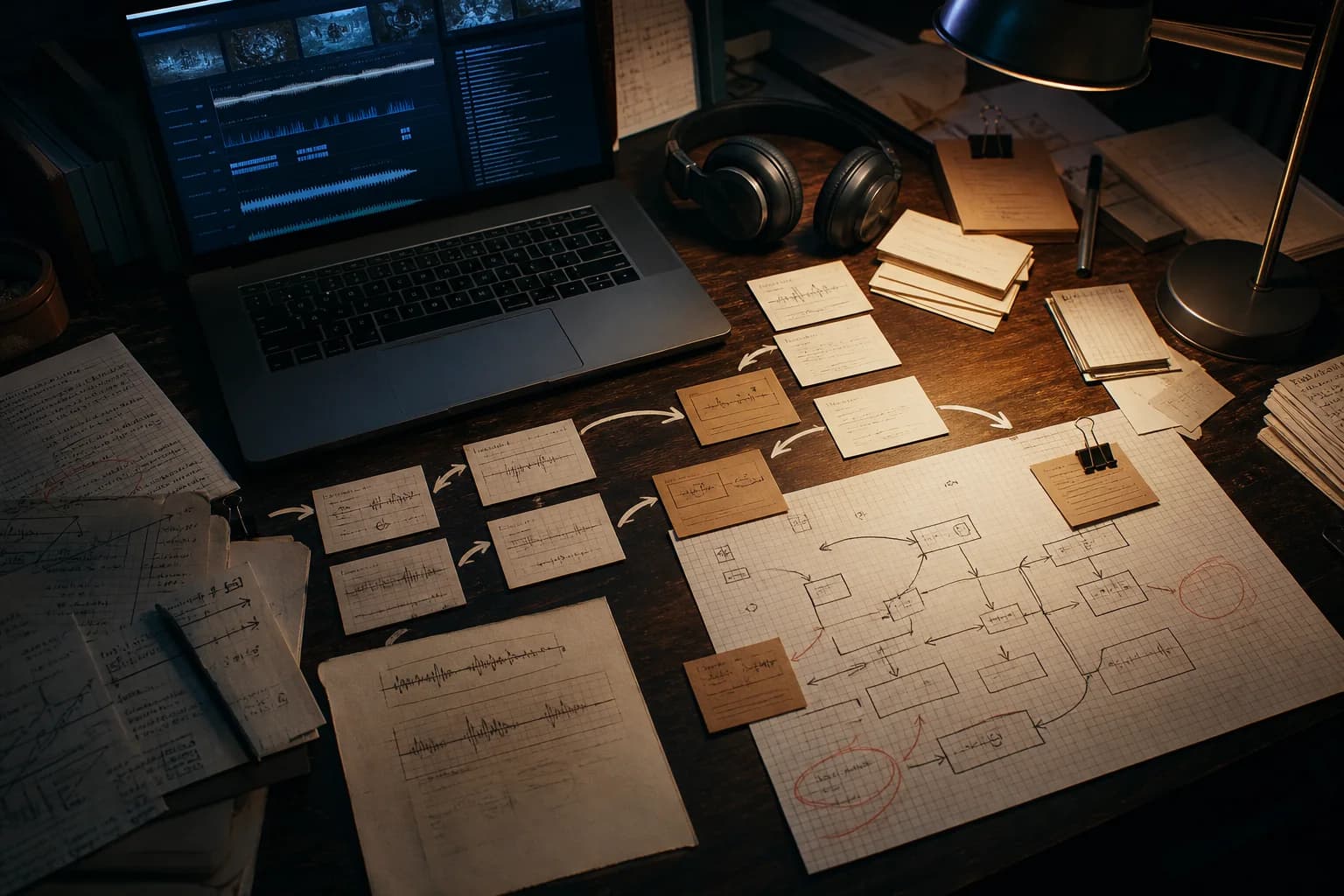
The content already existed. The missing part was a system capable of turning it into knowledge.
YouTube playlists   Coursera
notes               bookmarks
search history partially watched videosFIELD OBSERVATION
The internet already contained the courses.
What it did not contain was a reliable way to turn those courses into a learning system.
A saved video is not yet knowledge.
Chapter 02
The video player was being treated as the learning environment instead of a source.
ASSUMPTION
A player provides playback, timeline, comments and recommendations.
It does not naturally provide curriculum, searchable transcripts, prerequisites, persistent context, review questions or semantic retrieval.
The first boundary to change was simple: the video should become a source, not the final interface.
Chapter 03
Convert one external URL into an internal learning object.
Spaces represent a subject or learning goal: Machine Learning, Advanced React or System Design.
The first model focused on one action: paste a URL and convert the external video into an internal learning object.
Chapter 04
A URL looked like one input but expanded into a long-running, failure-prone pipeline.
The interface made ingestion look like one action.
The system revealed that it was a pipeline.
Chapter 05
Model learning conversion as separate asynchronous jobs with independent failure boundaries.
PROTOCOL
Existing captions are faster, cheaper and avoid unnecessary GPU work.
Whisper remains necessary because not every source contains usable captions.
Chapter 06
Web capture, API state, durable data, queues and workers form one inspectable pipeline.
ingestion    yt-dlp
transcript   FFmpeg + faster-whisper
summary      heuristic / OpenRouter / Ollama
curriculum   dependency graph + topological sort
search MeilisearchThe heuristic provider preserves baseline functionality when remote or local model providers are unavailable.
Manual curriculum reordering persists immediately without rebuilding the entire curriculum.
Chapter 07
The pipeline gains specialization while accepting explicit operational complexity.
The interface stays in Next.js; Python-native ingestion and transcription stay in FastAPI.
Trade-off: two runtimes and more deployment complexity.
PostgreSQL remains the source of truth; Meilisearch serves retrieval.
Trade-off: indexing consistency must be managed.
Explicit jobs and in-context capture reduce user friction.
Trade-off: worker supervision, retry, authentication and configuration become operational concerns.
Chapter 08
Quality and availability depend on source media, workers, indexes and configured providers.
CURRENT LIMIT
Chapter 09
The next iteration should make workflows more durable, attributable and resource-aware.
NEXT EXTRACTION
Chapter 10
The tools and boundaries behind the learning conversion pipeline.
VERIFIED
web: Next.js + Zustand + browser extension
api: FastAPI + Pydantic + JWT
data: PostgreSQL + SQLAlchemy
queues: Redis + RQ
media: yt-dlp + FFmpeg + faster-whisper
search: Meilisearch
providers: heuristic / OpenRouter / OllamaRecall began by saving videos. The system only became coherent when the video stopped being the destination and became raw material for a learning structure.
Back cover
The video became raw material for a learning structure.